When we talk about the grief cycle, most people picture a funeral. But grief turns up wherever something ends, and divorce is one of the biggest endings there is.
During my own divorce I wasn't just grieving a marriage. I was grieving the family unit. The four of us round a table. Not having my children with me all of the time, and the silence of a house on the nights they weren't there. The house itself, the one I'd lived in, decorated, imagined the future in. Friendships that quietly picked a side. Routines, traditions, the version of my life I'd assumed I'd keep.
That is a huge amount to grieve. And I think we underestimate it, because there's no ceremony for it and no one sends flowers. So the first thing I'd say, before any tool or technique: you have to be kind to yourself. You are grieving. Treat yourself the way you would treat a friend who was.
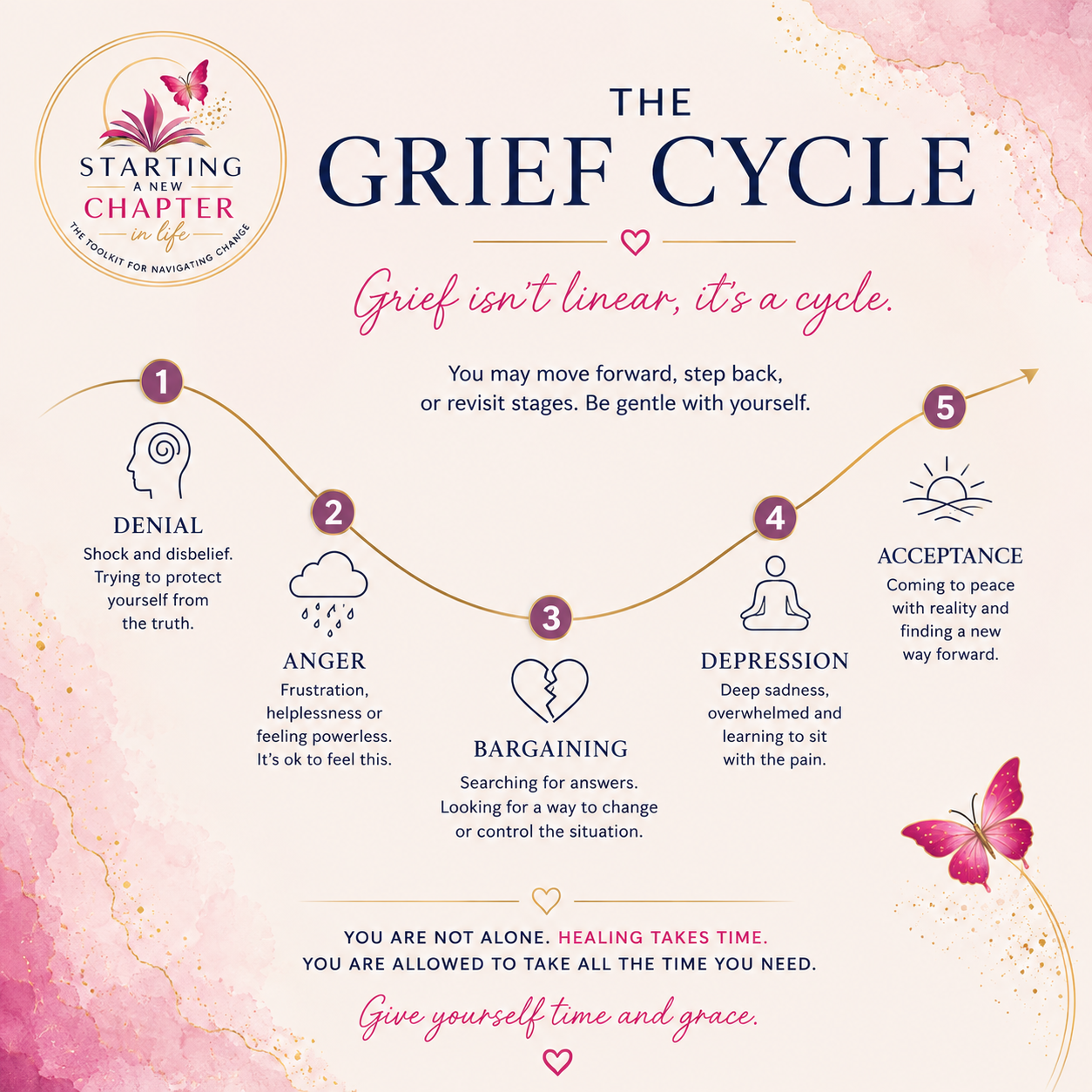
The five stages, in real life
It's never as tidy as the diagram. You loop back, you skip ahead, you have a brilliant week and then a Wednesday floors you. But knowing which stage you're in takes the fear out of it, you stop thinking something is wrong with you and start recognising a process.
Stage 1
Denial
This isn't really happening. We'll work it out. I kept going, kept smiling, kept the diary full, because if I stopped moving I'd have to feel it. Denial is not weakness, it's your mind buying you time.
Stage 2
Anger
At him, at myself, at the paperwork, at whoever asked how I was doing in the school playground. Anger gets a bad name, but it's energy. The trick is choosing where you put it.
Stage 3
Bargaining
If I'd done this differently. If we'd tried one more time. The endless rerunning of a story that already ended. This is where a good coach earns their money, because you can't referee your own thoughts.
Stage 4
Depression
The quiet Tuesdays when the kids aren't with you and the house is too still. This is the stage nobody photographs. Be kind to yourself here. Lower the bar, ask for help, keep one small routine.
Stage 5
Acceptance
Not approval. Not 'I'm glad it happened'. Just: this is my life now, and I get to decide what happens next. Acceptance is where planning finally becomes possible.
And then there's the work question
On top of all the emotion sits something very practical. You may not have worked for years, or at all since the children arrived, and suddenly you're facing a huge financial and identity shift, working out how on earth you get back into the workplace.
That fear is real, and it doesn't mean you're not capable. It usually means your confidence took the hit, not your ability.
“You are not starting from scratch. You are starting from experience.”
What actually helped me
These are the things that moved me through the cycle rather than round it, and they're the same four things I now offer mums going through divorce through my work with Supermums.org.
A support group of people on the same road
Nothing shifted things faster than being in a room, often a Zoom room, with other mums who just got it. No explaining, no performing. Community is the single thing I'd give every woman going through divorce.
Career and life coaching for your mental health
Coaching gave me somewhere to put the swirl. Not therapy, not advice, structured space to think clearly, decide what I wanted, and turn it into a plan I could actually act on.
Learning a new skill
Learning something concrete does two things at once: it rebuilds the confidence divorce dents, and it gives you a route back into work. That's exactly why I built Supermums, to train mums into tech careers with flexibility built in.
Doing things that lift you
Walks, swimming, dancing in the kitchen, a course, a coffee with someone who makes you laugh. Motivation follows action, not the other way round. Endorphins are a legitimate part of the plan.
If you're somewhere in the middle of this right now, you don't need to have the whole next chapter written. You just need the next honest step, and someone alongside you while you take it.