Redundancy rarely feels like a business decision when you're the one receiving it. It feels personal. And what follows isn't a straight line from bad news to new job — it's a roller coaster, and it's grief.
You're not just grieving the salary. You're grieving the team, the routine, the identity you introduced yourself with at parties, the plan you'd quietly built on top of that income. There's no ceremony for it and nobody sends flowers, so the first thing I'd say is this: be kind to yourself. You are grieving. Treat yourself the way you'd treat a friend who was.
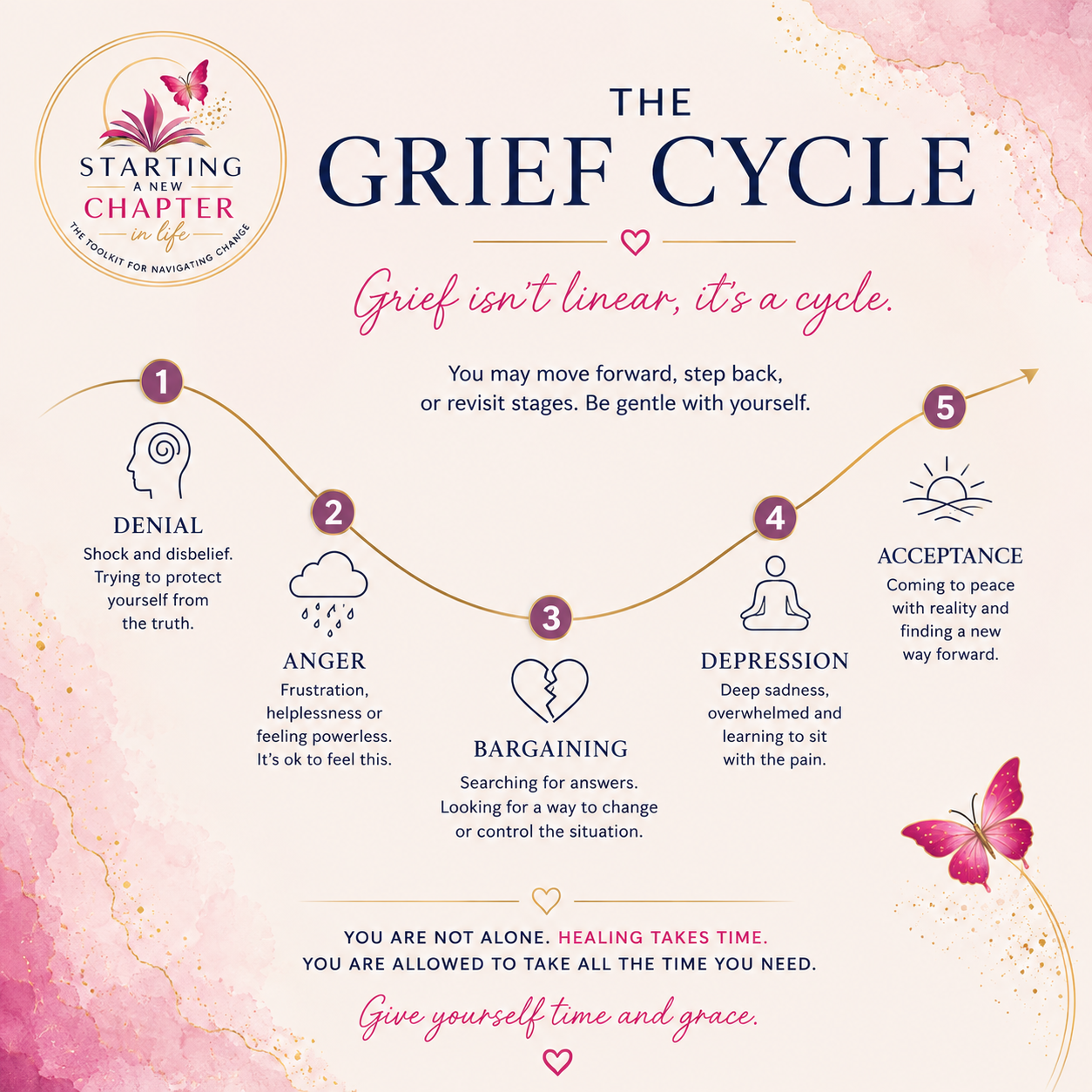
The five stages, after redundancy
It's never as tidy as the diagram. You loop back, you skip ahead, you have a brilliant week of applications and then a Wednesday floors you. But knowing which stage you're in takes the fear out of it — you stop thinking something is wrong with you and start recognising a process.
Stage 1
Denial
Something will come up. They'll change their mind. You keep the routine going, keep applying half-heartedly, keep telling people it's fine. Denial isn't weakness — it's your mind buying you time before the full weight lands.
Stage 2
Anger
At the decision, the process, the person who kept their role, the recruiter who never replied. Anger is energy, and it has to go somewhere. If you don't choose where, it usually lands on the people at home who had nothing to do with it.
Stage 3
Bargaining
If I'd spoken up in that meeting. If I'd taken the other project. Endlessly rerunning a story that has already ended. You can't referee your own thoughts — this is where writing, or a coach, earns its keep.
Stage 4
Depression
The quiet weekday mornings when everyone else is logged on and you're not. Redundancy takes your income and your identity in the same envelope. Lower the bar, keep one small routine, and ask for help.
Stage 5
Acceptance
Not approval. Just: this is where I am, and I get to decide what happens next. Acceptance is the point at which planning — CV, skills, applications — finally becomes possible.
Don't take it out on the people around you
Here's the bit nobody warns you about. When all of that emotion has nowhere to go, it leaks. It comes out as snapping at your partner, short answers to your children, silence at dinner, a row about the dishwasher that was never about the dishwasher.
The people who love you become the audience for feelings that belong to a company decision. That's not a character flaw — it's unexpressed emotion looking for an exit. So give it a safe one first.
When we keep things in our head, they don't resolve, they circle. The moment a thought is on the page it stops being a feeling and becomes a fact you can examine. You can agree with it, argue with it, cross it out. You'll notice the thing keeping you awake takes up two lines, while the thing you never mention fills half a page.
“Better out on the page than out on the people you love.”
Step one: the brain dump
Unedited, unstructured, no audience. Everything you're angry about, ashamed of, scared of. I did this on a flight once — four hours, no wifi, nowhere to be — and wrote down every reason I needed to change something and what each one was really about. By the time we landed I felt free. Nothing had been solved mid-air; I'd just stopped carrying it round and round in my head.
Step two: use the grief cycle as your frame
A blank page can be daunting, and it's easy to write in circles. So use the five stages above as your structure. Take each one in turn and either speak it out loud to someone you trust, or write it down. Both work — the point is that it leaves your body.
Don't edit and don't be fair. If you feel low, write down exactly why you feel low. If you're furious, write down who with and what about. It's okay to feel it. We just want it out, in a safe place, rather than landing on the people around you.
Denial
What am I still not saying out loud? Write the sentence you've been avoiding: "I have been made redundant, and it means…"
Anger
Who or what am I angry at, and why? Name every single one. Don't be reasonable or fair — this page isn't for anyone else.
Bargaining
What am I replaying? Write the "if only I had…" list, then read it back and ask honestly: would that actually have changed the decision?
Depression
Why do I feel low today? Write it plainly. It's okay to feel it — the point is to feel it on the page rather than carry it round all week.
Acceptance
What opportunities could this hold? What could this mean for me? What could a new future actually look like — and what would I want in it?
Spend most of your time on the last one. Acceptance is where the page stops being a release valve and starts becoming a plan.
Push and pull
Here's the thing about redundancy: it's a push. Something happened to you and pushed you out. Push is loud, it's unfair, and it will happily take up every hour you give it.
But you can't be pushed into your next chapter — you have to be pulled into it. Pulls are the things you actually want: the kind of work, the flexibility, the people, the skill you've been curious about for years. We can't move on if we stay in the push zone.
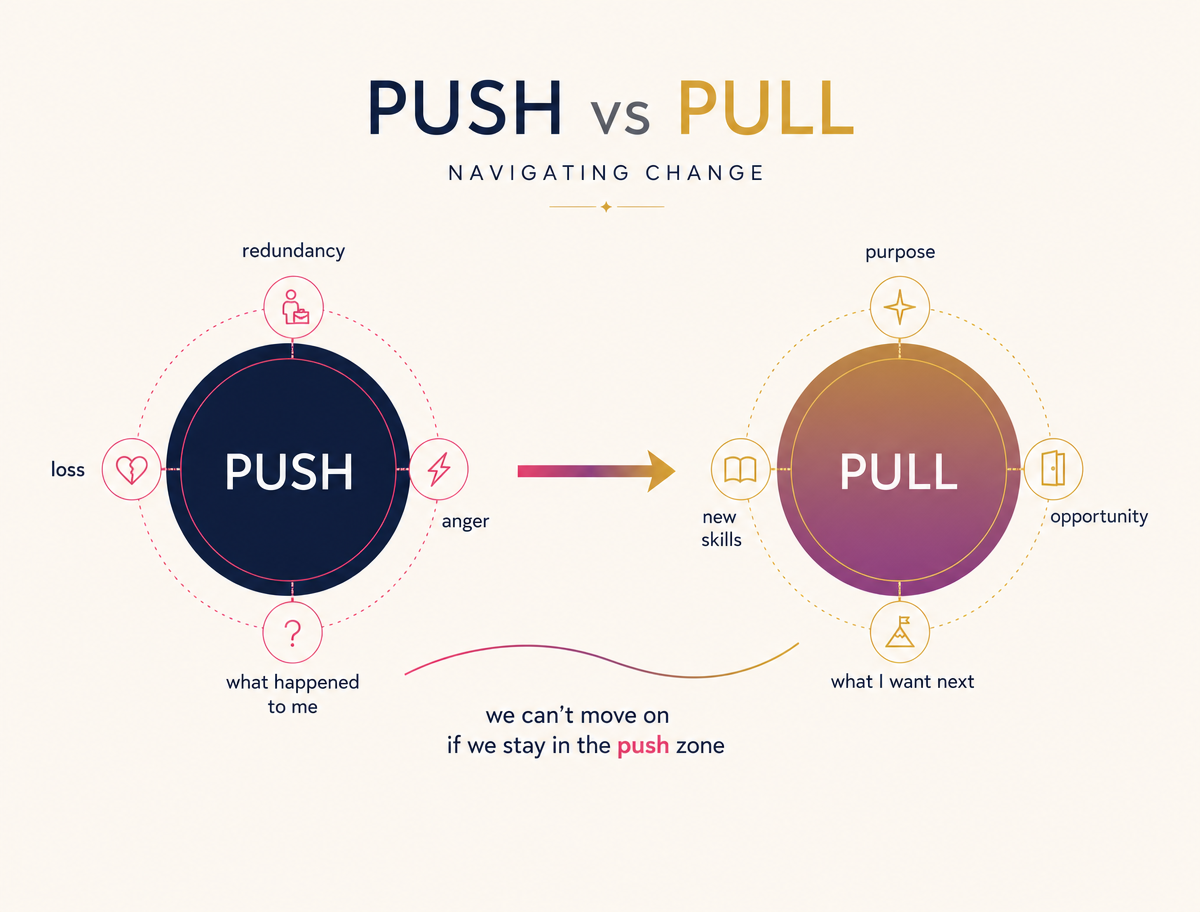
So write two lists. Everything pushing you (what you're leaving, what you never want again), and everything pulling you (what you want next, and why). When the pull list is longer than the push list, you've turned the corner.
Step three: turn it into a plan
Once the emotion is out and the picture is honest, the practical work becomes possible: what you're good at, which market wants it, and how you tell that story on a CV and in an interview. Learning a concrete new skill does two things at once — it rebuilds the confidence redundancy dents, and it gives you a route back in.
If you're curious about where the jobs actually are right now, my free Relaunch Your Career Masterclass walks you through the roles opening up in tech and AI and which might suit you.
And if you'd rather not do the emotional part alone, that's exactly what coaching is for — one-to-one or in a small group, with someone in your corner while you work it out.
Free masterclass
Relaunch Your Career Masterclass
Discover new job roles in tech and AI that might suit you — free to register.
Coaching
One-to-one and group coaching
Four weeks to move from the roller coaster to a clear, practical plan.
Make a change