
Knowing your own superpowers is so important for your personal confidence, self-esteem and belief system, as well as for enabling you to work well as part of a team at home and at work.
We are all brilliant at some things and rubbish at others and that’s okay…
It’s important to accept and understand what we are not good at.
It’s incredibly valuable to recognise and own what we are excellent at.
It’s also important to appreciate the skills that others bring to the team.
One of the biggest pain points in relationships, both at home and at work, is people complaining about others and what they are not doing right. Why is that?
- Maybe they are in the wrong job or doing the wrong tasks.
- Maybe they are not taking ownership of the right tasks—the ones that align with their superpowers.
- Are we trying to fit a round peg into a square hole? Is something not working for a reason?
To thrive in life, we need to stay in our lane…
- We need to know what we are brilliant at and communicate that effectively within a team.
- We need to focus on tasks and jobs in which we can excel.
- We need to build a team around us, at home and at work, and offload the things we are not good at.
- We need to surround ourselves with people who know our strengths and understand our weaknesses.
- We need to remove people from our lives who tell us we are rubbish at things, do not work well as part of a team and expect us to be good at everything.
Understanding yourself
There are various exercises you can do to start understanding your own superpowers and the contribution you make as part of a team.
Personality assessment tools can be a great starting point. At work, teams often go through this process at team-building events; at home, it can be just as valuable. The same concepts apply.
The assessments do not need to define you, but they can help you understand things objectively and recognise the role we all play. Going through this process can be enlightening. It can help you make sense of your differences and understand how to work together as a team.
Working as a Team
To work as a high-performing team at home or at work, we need to:
Appreciate that a great team comprises people with a range of skills and different superpowers.
Know and communicate our value, skills and contribution to the team.
Appreciate and understand the contributions of other team members, recognising that they are different from us.
Identify any missing skills. Someone within the team may need to learn them, or someone new may need to be recruited to fill the gap.
Personality and team assessments
Personality and team assessments give us a shared language for understanding how people think, communicate and contribute. They should reveal preferences rather than define our abilities or place us into rigid boxes.
- Big Five measures openness, conscientiousness, extraversion, agreeableness and emotional sensitivity. It has a strong research base.
- Myers–Briggs (MBTI) describes preferences across four dimensions, producing types such as ENFP or ISTJ. It is accessible and useful for reflection, although less scientifically robust than the Big Five.
- DISC focuses on observable working and communication styles: Dominance, Influence, Steadiness and Conscientiousness.
- CliftonStrengths identifies recurring talents and helps people understand where they can contribute most naturally.
- Belbin Team Roles examines the roles people adopt within a team, such as Coordinator, Implementer or Plant.
- The Enneagram explores nine personality patterns and their underlying motivations, fears and behaviours.
- Wealth Dynamics and Talent Dynamics focus on how people naturally create value and where they experience the greatest sense of flow.
The greatest benefit comes from combining an assessment with honest discussion:
- What gives me energy?
- What drains me?
- What contribution do I make naturally?
- Where do I need help?
- How should other people communicate with me?
The personality profiling test that resonated with me most was one focused on building business teams, but it can also be applied to home life.
Roger Hamilton’s Wealth Dynamics model
Roger James Hamilton created Wealth Dynamics as a profiling system for entrepreneurs. It helps people identify their natural strengths, recognise potential weaknesses and build complementary teams. The model contains eight profiles, including Creator, Star and Mechanic.
The eight profiles are arranged around four principal energies:
- Dynamo: Ideas, innovation, vision and new beginnings.
- Blaze: Communication, relationships, enthusiasm and influence.
- Tempo: Timing, service, stability and connection to people.
- Steel: Systems, detail, data, efficiency and control.
We can all use these four energies, but some will feel more natural and energising than others.
Creator
Core energy: Dynamo Creates value through: New ideas, products and possibilities.
Creators see what could exist. They are visionary, imaginative and comfortable beginning something from nothing. They often move quickly and prefer creating the next idea to maintaining the current one.
Natural strengths: Innovation, original thinking, seeing the big picture, starting projects and inspiring others with possibilities.
Potential challenges: Too many ideas, losing interest in implementation, overlooking detail and starting before testing the practicalities.
At work: A Creator proposes a new service, sketches the customer journey and excites the team. Once the concept is established, they may need a Mechanic or Accumulator to turn it into a repeatable operation.
At home: They suggest transforming the spare room, plan an adventurous holiday or invent a new family routine. They may buy all the supplies enthusiastically but leave someone else to finish the project.
What they need: Freedom to create, plus support with priorities, detail and completion.
Star
Core energy: Dynamo and Blaze Creates value through: Personal brand, communication and visibility.
Stars naturally attract attention to an idea, cause or organisation. They are expressive, quick-thinking and often persuasive. Their value grows when they are visible and able to communicate authentically.
Natural strengths: Presentation, storytelling, promotion, influence and making ideas memorable.
Potential challenges: Becoming the centre of everything, overcommitting, reacting emotionally to criticism and focusing on visibility more than delivery.
At work: A Star is excellent at pitching, speaking at events, leading a campaign or becoming the public face of a business. They need a strong team behind them to fulfil what has been promised.
At home: They bring energy to celebrations, tell engaging stories and motivate everyone to participate. They may become frustrated when the family does not match their enthusiasm.
What they need: Opportunities to communicate, with trusted people managing detail and follow-through.
Supporter
Core energy: Blaze Creates value through: Leadership, relationships and team energy.
Supporters bring out the best in people. They are natural connectors who build trust, enthusiasm and belonging. They frequently succeed by helping talented people work effectively together.
Natural strengths: Motivating and encouraging people, networking, building loyalty and creating team spirit.
Potential challenges: Avoiding difficult decisions, prioritising harmony over performance, absorbing other people’s emotions and neglecting systems or detail.
At work: A Supporter leads a team, notices when someone is struggling and creates the conditions for collaboration. They may need a Steel-energy colleague to track measures, processes and deadlines.
At home: They organise family gatherings, check how everyone feels and help resolve disagreements. They may do too much for other people or find it difficult to establish boundaries.
What they need: Interaction, appreciation and a team to support—without becoming responsible for everyone.
Deal Maker
Core energy: Blaze and Tempo Creates value through: Relationships, negotiation and well-timed opportunities.
Deal Makers understand people and connect them with the right opportunities. They build trust before doing business and often rely on conversation, intuition and timing.
Natural strengths: Negotiation, reading people, connecting complementary individuals and maintaining valuable relationships.
Potential challenges: Depending too heavily on particular relationships, agreeing things without documenting the details, becoming distracted by new opportunities and avoiding conflict to preserve rapport.
At work: A Deal Maker introduces a client to the right specialist, negotiates the terms and creates a partnership that benefits everyone.
At home: They negotiate compromises between family members and know whom to contact when something needs arranging. They may make informal commitments without checking the practical details.
What they need: Time to build relationships, supported by clear agreements and reliable administration.
Trader
Core energy: Tempo Creates value through: Timing, service and understanding current needs.
Traders are grounded in what is happening now. They listen carefully, recognise practical needs and make measured decisions based on immediate conditions.
Natural strengths: Listening, observation, customer awareness, timing decisions carefully and providing dependable service.
Potential challenges: Becoming absorbed in day-to-day demands, reacting rather than planning, missing longer-term possibilities and finding rapid change uncomfortable.
At work: A Trader monitors customers, capacity and changing conditions, adjusting services at the right time. They help ensure that ideas match what people actually need.
At home: They notice when supplies are running low, respond to changing family needs and keep daily life moving. They may focus on immediate problems rather than future planning.
What they need: Direct contact with people and current information, balanced by a clear longer-term direction.
Accumulator
Core energy: Tempo and Steel Creates value through: Careful collection, organisation and long-term growth.
Accumulators are patient, dependable and cautious. They prefer evidence and gradual progress to dramatic risks. They often protect and steadily develop resources over time.
Natural strengths: Planning, preparation, reliability, risk management and long-term thinking.
Potential challenges: Waiting too long to act, discomfort with uncertainty, excessive caution and holding onto things that no longer serve a purpose.
At work: An Accumulator develops a sensible implementation plan, checks the risks and ensures resources are available before committing.
At home: They manage savings, store important documents and plan holidays well in advance. They may resist a spontaneous purchase or sudden change of plan.
What they need: Time, evidence and a stable plan—with encouragement to act before every detail is certain.
Lord
Core energy: Steel Creates value through: Detail, numbers, control and the efficient use of resources.
Lords are analytical and precise. They often work effectively behind the scenes, finding value that other people overlook. They usually prefer control of resources to responsibility for motivating a large group.
Natural strengths: Financial and data analysis, attention to detail, resource management and improving profitability.
Potential challenges: Becoming isolated, micromanaging, under-communicating and valuing measurable results while overlooking emotions.
At work: A Lord analyses costs and discovers where money, time or capacity is being wasted. They build controls that improve financial performance.
At home: They manage the household budget, compare prices and keep accurate records. Other family members may experience their questions as criticism when they are trying to create control.
What they need: Autonomy, accurate information and defined responsibility, alongside support with communication and relationships.
Mechanic
Core energy: Steel and Dynamo Creates value through: Better systems and continuous improvement.
Mechanics take an existing idea and make it work more effectively. Where the Creator asks, “What could we invent?”, the Mechanic asks, “How could this work better?”
Natural strengths: Designing systems, solving complex problems, improving quality and turning ideas into repeatable processes.
Potential challenges: Perfectionism, continually redesigning rather than releasing, becoming frustrated by inefficiency and explaining systems in more detail than others need.
At work: A Mechanic automates a manual process, improves the customer journey and creates a repeatable system that reduces mistakes.
At home: They devise an efficient storage system, research the best technology or create a detailed routine for household tasks. They may keep refining the system when everyone else simply wants something that works.
What they need: Complex problems and freedom to improve systems, balanced by deadlines and a clear definition of “good enough.”
Applying in practice
Make time to have this conversation with your team members at work or at home. Look at the model, explore its different components and identify your strengths. You can do this alone, but it is equally valuable to work through it as a team. This creates a shared understanding of how the team can work well together and what everyone brings to the table.
The model is most helpful when we say, “This explains where I contribute naturally,” rather than, “That task isn’t my type, so I cannot do it.” It is a development and discussion tool—not a clinical diagnosis or a definitive measure of capability.
Chapter 4 · At a glance
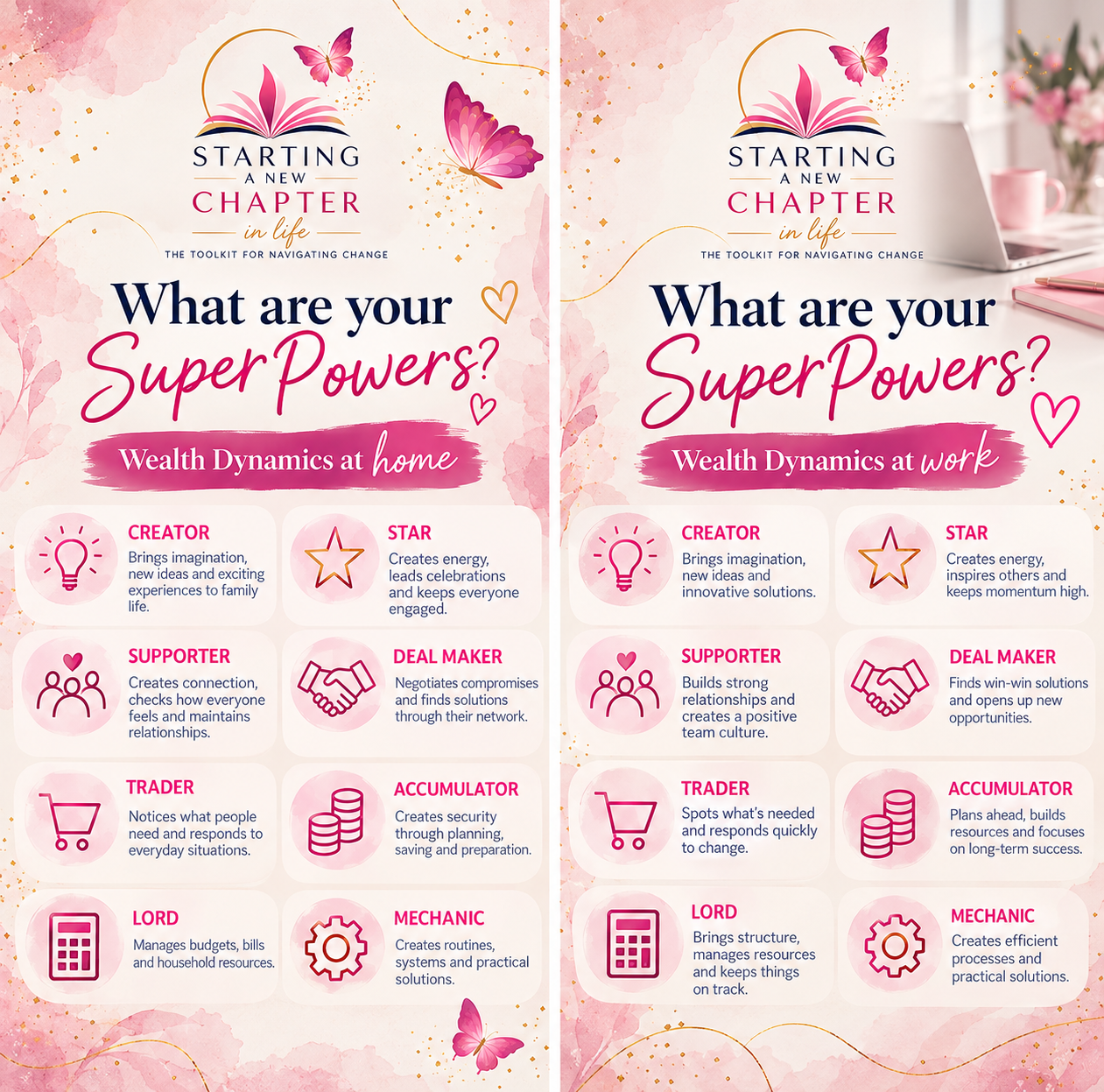
The eight profiles, side by side
Two ways to see how your strengths can contribute — and where someone else’s strengths might complement yours.
Further reading
Take action to identify your superpowers today and shift the way you see yourself and how you play in a team.
Sunday blessing
Follow us on social media for the next chapter
New tools to navigate change, every week. My Sunday blessing to you.
Share this post
Instagram doesn't allow direct web sharing, so we copy the link for you to paste into your story, caption or bio.
Keep reading